.png?width=126&height=101&name=logo%20(2).png)
.png)


On 8 October 2026, FINMA adopted the partial revision of Circular 2016/7 "Video and online identification". The revised circular enters into force on 1 November 2026. As a result, the e-ID can also be used for digital onboarding, ID documents with a QR code are recognised, and the requirements for protection against identity fraud are increasing.
The changes at a glance
- The partially revised circular applies from 1 November 2026.
- The Swiss e-ID is permitted for online identification, but not for video identification.
- ID documents with a QR code are treated the same as ID documents with a machine-readable zone (MRZ).
- Liveness detection is also mandatory for identification by means of a QES or the e-ID.
- Residence verification (or address verification) can be carried out using equivalent digital methods.
- A one-year transition period applies to residence verification and liveness detection for QES-based identification, i.e. until the end of October 2027. No transition period applies to the e-ID.
Background to the revision
Circular 2016/7 sets out how financial intermediaries fulfil their due diligence obligations when identifying customers via digital channels. The partial revision was prompted primarily by the new Federal Act on Electronic Identity Credentials (e-ID Act). According to the Federal Council, the state e-ID is expected to be rolled out in the first half of 2027.
At the same time, FINMA is responding to new fraud patterns. AI-generated images and deepfakes make it easier to impersonate someone else. The revision therefore broadens the permitted methods while raising security requirements.
What was adopted from the consultation draft
The e-ID as a means of identification
Financial intermediaries may require customers to present an e-ID. They verify that the e-ID was issued to the contracting party and is valid, verify the place of residence and document the identification process.
ID documents with a QR code
Until now, only ID documents with an MRZ were permitted for video and online identification. ID documents with a QR code, such as the credit-card-sized Swiss driving licence, are now treated equally. Financial intermediaries continue to decide for themselves which documents they consider sufficiently secure.
Residence verification for QES-based identification
When identifying customers by means of a qualified electronic signature (QES), their place of residence must also be verified. The majority of consultation participants had rejected this requirement. According to the consultation report (in German), FINMA is maintaining it.
Legal entities
The QES, digital confirmation of authenticity and the e-ID are now explicitly available for identifying the persons acting on behalf of a legal entity. Residence verification is still required.
Bank transfer
Bank transfers as a security element remain restricted to banks. According to FINMA's explanatory notes (in German), credit card issuers and payment services such as PayPal or Twint do not qualify as banks within the meaning of the circular.
What was not adopted
FINMA did not take the following consultation requests into account:
|
Request |
Decision |
FINMA's reasoning |
|
e-ID for video identification as well |
Rejected |
The e-ID has neither an MRZ nor a QR code and is therefore intended for online identification only. |
|
Waiving residence verification for QES and e-ID |
Rejected |
Residence verification remains necessary as an additional security element (see above). |
|
Advanced signatures instead of the QES |
Rejected |
Identification by means of a QES will not be extended. |
|
Recognition of eIDAS credentials from the EU |
Not currently planned |
The technical and regulatory basis is lacking. |
|
Technology-neutral wording |
Rejected |
FINMA relies on clear requirements and will assess new technologies in future revisions. |
|
Catalogue of possible identification elements instead of detailed requirements |
Rejected |
Minimum supervisory standards remain necessary. |
|
Reverse bank transfer and other payment service providers |
Rejected |
The transfer must still originate from a bank. |
|
Waiving residence verification for legal entities |
Rejected |
The address of the natural persons acting on behalf of the entity must still be verified. |
What financial intermediaries need to implement now
The need for action depends on which identification methods an institution uses. The starting point is a comparison of existing onboarding processes with the revised circular.
QES-based identification
- Integrate residence verification into the QES process.
- Introduce liveness detection to ensure that the request originates from the contracting party.
e-ID
- Decide whether and from when to offer the e-ID.
- Implement technical verification of the issuance and validity of the e-ID.
- Integrate residence verification, liveness detection and documentation from the outset, as no transition period applies.
- Retain alternative methods for customers without an e-ID.
ID documents with a QR code
- Define which ID documents with a QR code are accepted and update the internal document list.
- Ensure that the solution in use can machine-read and decode QR codes.
Cross-cutting points
- Assess whether digital methods can supplement or replace the existing residence verification, and document their suitability in a traceable manner.
- Accept bank transfers from banks only, not from credit card issuers or payment services.
- Update internal directives, process descriptions and training to reflect the revised version.
Timeline and deadlines
|
Date |
What applies |
|
8 October 2026 |
Publication of the partially revised circular, the consultation report and the explanatory notes. |
|
1 November 2026 |
Entry into force. ID documents with a QR code and digital methods for residence verification are permitted from this date. The requirements for the e-ID, including liveness detection, apply without a transition period. |
|
End of October 2027 |
End of the transition period. Residence verification and liveness detection for QES-based identification must be implemented. |
PXL Vision: 100% ready for the new requirements
PXL Vision already meets the requirements of the revised circular today:
- QES: Both PXL Sign and PXL GwG Ident combine identification and qualified electronic signature in a single process.
- e-ID: The e-ID is already integrated into PXL Ident and ready for use from the launch of the state e-ID. Customers without an e-ID can still be verified via conventional automated identification.
- Residence verification: Residence verification via the Swiss Post database has long been available as an add-on and can be integrated directly into the onboarding process without delaying it.
- Liveness detection: Passive liveness detection is integrated into PXL Vision solutions as standard.
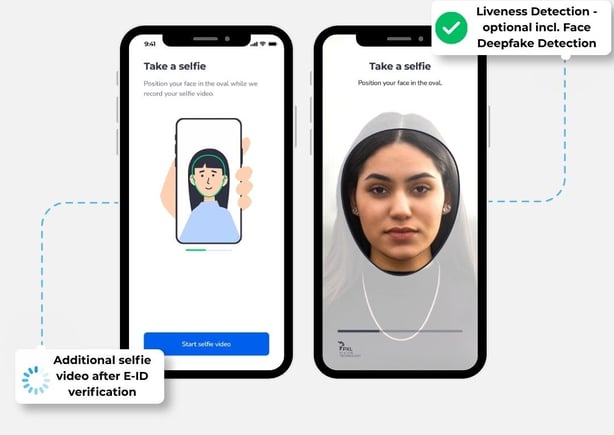 For verification via e-ID, liveness can then easily be confirmed, for example with a short selfie video. Adding the selfie video also allows additional security checks to run in the background, such as detecting deepfakes or injection attacks.
With PXL Vision, financial intermediaries can therefore adapt their onboarding processes to the new requirements even before the transition period ends.
If you would like to adapt your existing processes or explore the topic further, feel free to contact us.
This article is for general information purposes only and does not constitute legal advice.