.png?width=126&height=101&name=logo%20(2).png)
.png)

Glossary Swiyu App
Swiyu App – Swiss eID wallet explained
The Swiyu App is the Swiss Confederation's official digital identity wallet, forming the central element of the new federal eID system. It allows users to securely store, manage and release their verified identity data directly on their device.
Following the principle of self-sovereign identity (SSI), users retain control over their data at all times without the state storing it centrally. But what role does the app play in the new eID system, and how does it affect digital processes within companies?
What is the Swiyu App?
The Swiyu app acts as a digital wallet for storing personal and government-verified identity data. The name is a portmanteau combining 'SW' for Switzerland, 'I' for identity/innovation, and 'YU' for you/unity.
The app is currently available for testing ahead of its full implementation alongside the introduction of the Swiss eID. Users can use it to securely store, manage and selectively share their digital identity data, for example for online government services or registration processes.
As a wallet, Swiyu forms the technical basis for using the eID:
- The e-ID itself is issued exclusively by the federal government.
- Swiyu enables its use in everyday life – similar to a digital identity folder.
- Its use is voluntary, as stipulated in the eID Act.
In the long term, Swiyu will be able to store not only eIDs, but also other digital credentials, such as driving licences, insurance certificates and membership cards. This creates a standardised, interoperable trust infrastructure that can be used by citizens and businesses alike.
Schedule: Launch of the Swiyu App in Switzerland
The introduction will take place in stages:
2024 – Legal basis
On 20 December 2024, the eID Act was passed and state responsibility was clearly regulated: only the federal government may issue eIDs.
2025 – Start of public beta
The Swiyu App has been available in a public test phase since 26 March 2025. Initial digital proofs can be tried out in demo form.
2026 – Planned productive launch
From summer 2026 at the earliest, and probably Q3 2026, the eID can be officially ordered and used regularly. Only from this point onwards will the app be fully usable in everyday life.
How verification will work in the Swiyu App in future
In order to use the eID, a one-time verification process is planned, which will be carried out entirely digitally. The final process is still being implemented, but the planned sequence has already been defined:
- Capturing identification documents
Users should be able to capture an official identification document – such as a Swiss passport or identity card – using a camera or NFC. The data is processed locally and forwarded in encrypted form. - Biometric liveness detection
A brief biometric check (e.g. facial recognition with liveness detection) is designed to ensure that a real person is present.
This serves to prevent fraud and complies with current standards for digital identity verification. - Validation by a government verification agency
The transmitted data is verified by a competent federal agency. The digital identity can only be created after successful validation. - Issuance of the eID
Once the verification process is complete, the eID is made available in the Swiyu App. It can then be used for government services or business applications.
The final process may change during the pilot phase. However, one thing is clear: the aim is to create a user-friendly, fully digital verification process that meets the highest security and data protection standards.
What data does the Swiyu App save?
The Swiyu app only stores data that is necessary for identity verification, such as name, date of birth, or nationality.
Key features:
- No central data storage: All identity data is stored locally on the device.
- No government profiles: The federal government has no access to complete data sets.
- Selective sharing: Companies only receive the information necessary for a particular process (e.g. confirmation of legal age without date of birth).
For companies, this means they can use verified identity data without having to manage sensitive raw data themselves.
Security & Data Protection
The security architecture of the Swiyu App is based on state-of-the-art cryptographic standards and hardware-supported security areas on modern smartphones such as Apple's Secure Enclave or TrustZone.
The solution follows four key government principles of the eID Act:
- Government responsibility: Only the federal government issues the eID.
- Data protection by design: Identity data is stored decentrally.
- Voluntary participation: Use of the eID is optional.
- Interoperability: The architecture aims for long-term compatibility with European standards such as eIDAS 2.0.
These principles make Swiyu a trustworthy, highly secure infrastructure – especially for regulated industries.
Technical trust infrastructure of the Swiyu App
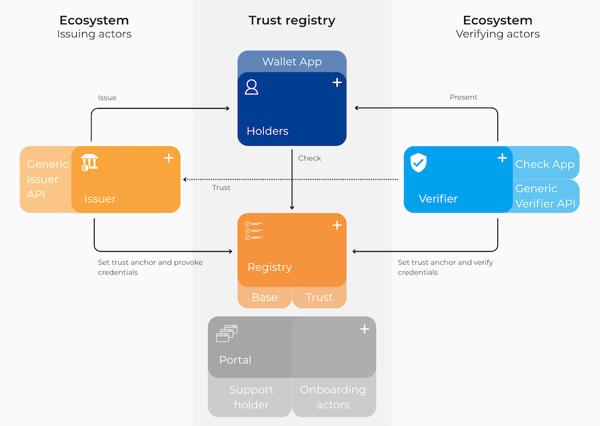
The Swiyu app is based on sophisticated technical and organisational trust infrastructure, enabling the secure exchange of digital credentials between citizens, businesses, and public authorities. Four roles are central to this process:
- Holders (wallet users): They can store their digital credentials in the app and generate cryptographic proof of use. They also have the option of deciding whether to release their data.
- Issuer: These bodies create digital certificates (e.g. the eID) and sign them cryptographically. They must be registered in the system and make their keys available in the infrastructure.
- Verifier: These are companies or authorities that verify digital credentials. They validate signatures, verify the legitimacy of the issuer, and check whether a credential is valid or has been revoked.
- Registries (Base Registry and Trust Registry):
- Base Registry: Public registry service of the Swiss Confederation, in which decentralised identifiers (DIDs) and their public keys are stored.
- Trust Registry: measures trust through the connection between DID and real-world entities (e.g. companies or public authorities) and, after verification, provides trust statements as verified credentials.
These components interact to ensure that every digital identity is based on reliable cryptography, clear governance and high interoperability. This provides companies with a number of concrete advantages, including a structure that enables standardised identity verification and is auditable, as well as offering open-source components and regulatory transparency.
Possible applications for businesses
The Swiyu app opens up a wide range of applications in digital processes for companies. Particularly relevant are:
Onboarding & account opening
Verified identity data can be efficiently integrated into digital registration processes. This reduces manual checks and speeds up the customer journey.
KYC and compliance requirements
The e-ID meets high security and reliability requirements, making it suitable for banks, insurance companies and other regulated industries.
Age verification
Companies can use Swiyu to carry out reliable age checks – an advantage, for example, for the sale of age-restricted products in online shops.
Interactions with authorities
In areas where companies regularly communicate with government agencies, Swiyu ensures consistent, verified identity data.
Secure customer interactions
The e-ID can serve as an additional security factor, for example when making sensitive changes to contract or account data.
This makes it clear that Swiyu is an important component of modern digital identity processes, though it will not cover all user groups. The eID was approved in the September 2025 referendum, but only by a narrow margin of 50.4%. This narrow approval indicates that not all users will adopt an eID, either due to personal preferences or technical limitations. Companies therefore still need hybrid identity strategies.
How PXL Vision supports businesses
PXL Vision helps companies integrate the capabilities of the Swiyu App into their existing verification processes in a sensible way. While Swiyu provides verified identity data, PXL Vision offers the flexibility to handle situations where an eID is unavailable or further checks are required.
With solutions such as Auto-Ident and NFC Ident, as well as comprehensive digital identity verification, PXL Vision can support all target groups, whether or not they have an eID. Companies benefit from the seamless combination of government identity and modern, AI-based verification.
The result is a consistent identity architecture that combines security, user-friendliness and regulatory compliance.
What companies should be planning now
The Swiyu App is a digital identity solution currently undergoing public testing and gradually being prepared for use. Companies should consider this development at an early stage and examine how eID-based identity data could be meaningfully integrated into their future onboarding, security and compliance processes. They should also consider how their existing systems can handle eID data and which alternative verification methods should remain in place alongside it.
It remains crucial, however, that alternative identification methods are available as a supplement, especially during the transition period when not all users will have an eID. A modern verification strategy combines government-issued identities with flexible verification procedures. PXL Vision supports companies in combining eID, Swiyu and other identity solutions to create a uniform, efficient identity verification process.